Physical Address
304 North Cardinal St.
Dorchester Center, MA 02124
Physical Address
304 North Cardinal St.
Dorchester Center, MA 02124

Everything about electronics
Everything about electronics
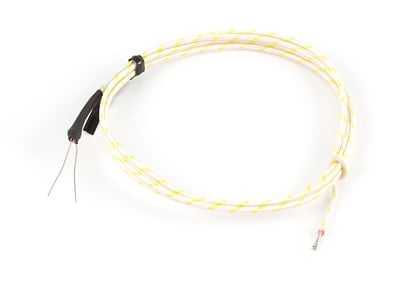
Although using a NTC can make your temperature measurement very easy. But for industrial purpose you can use a thermocouple for better stability and wider range.
Thermocouple
Thermocouple consists of two different conductors forming an electrical junction at different temperatures.
Due to thermo effect, thermocouples produce a voltage which is dependent on temperature.
Temperature can be found out from this voltage.
ADC output of this voltage can be processed by a microcontroller to give the temperature.
We can also use MAX6675 if we wish to fet the data in 12 bit SPI format.
(adsbygoogle = window.adsbygoogle || []).push({});
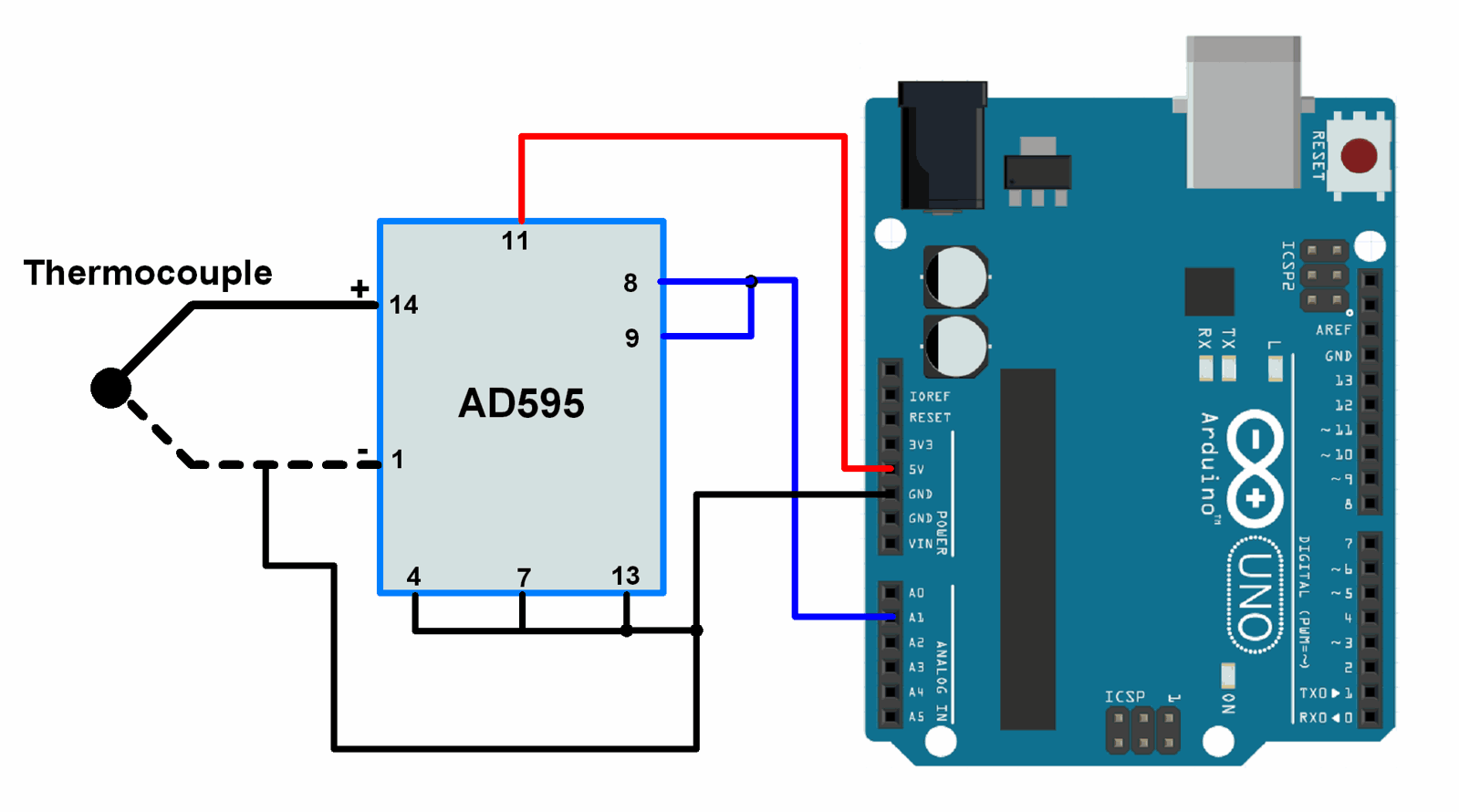
Interfacing Thermocouple With Arduino UNO
Measuring temperature using thermocouple and displaying it on Arduino serial monitor.
Here, AD595 is used to connect thermocouple to UNO board. The output voltage from AD595 is given to ADC of UNO board.
The ADC value is then converted into ºC using the formula given below.
º
Why 0.0027 subtracted in above formula
AD595 provides output as follows,
AD595 Output = (Type K Voltage + 11 uV) x 247.3
Note : 11 uV is an offset voltage of IC AD595 instrumentation amplifier for K-type thermocouple.
AD595 Output = (Type K Voltage + 11 uV) x 247.3
(adsbygoogle = window.adsbygoogle || []).push({});
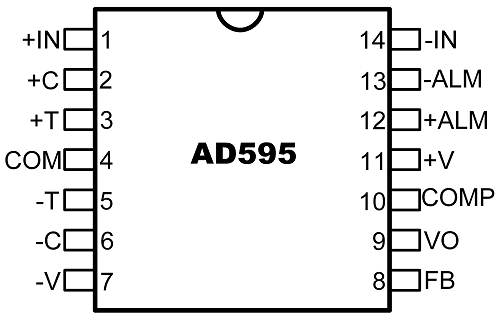
Pin Diagram of AD595
Note: If you connect +5 volt and ground to the AD595 you can measure the temperature from 0ºC to +300ºC. For more information, refer AD595 datasheet.
const int thermocouple_input = A1;	/* AD595 O/P pin */

void setup() {
  Serial.begin(9600);	/* Define baud rate for serial communication */
}

void loop() {
  int adc_val;
  float temperature;
  adc_val = analogRead(thermocouple_input);
  temperature = ( ((adc_val * 4.88) - 0.0027 ) / 10.0 );
  Serial.print("Temperature = ");
  Serial.print(temperature);
  Serial.print("nn");
  delay(1000);
}
(adsbygoogle = window.adsbygoogle || []).push({});


