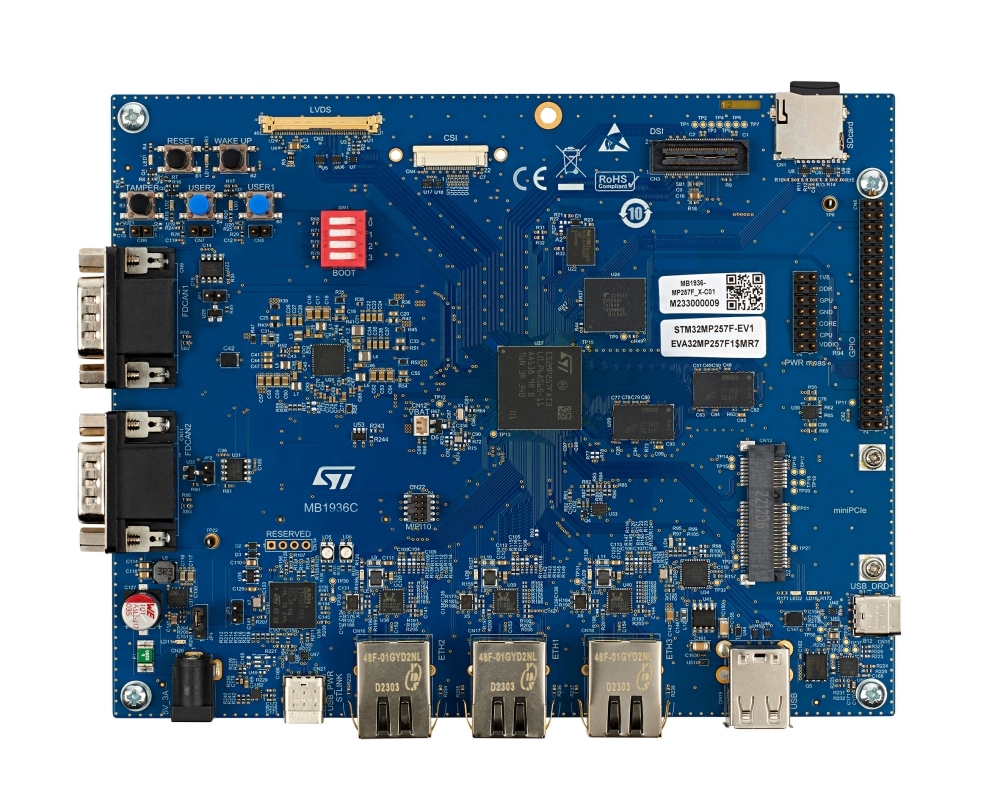
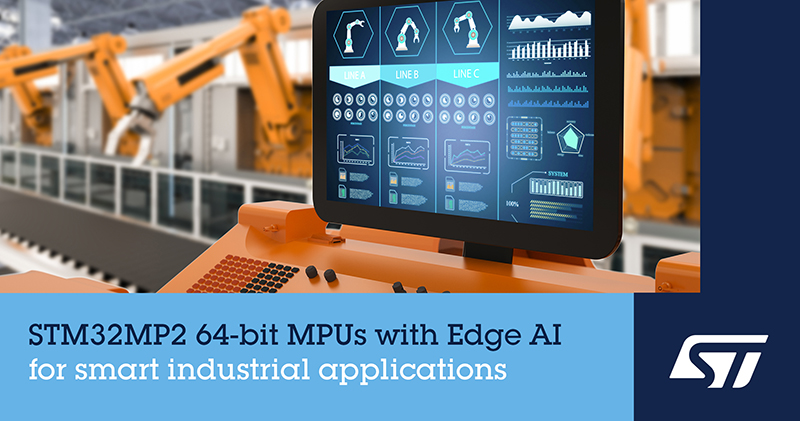
STMicroelectronics (ST) has launched its next-generation microprocessor family: the STM32MP2 series, aimed at industrial, IoT-edge and AI-enabled applications. This series marks a major upgrade over the previous generation by moving to 64-bit cores, adding a dedicated NPU (Neural Processing Unit) and strengthening connectivity, multimedia and security capabilities. For designers like you (working on embedded systems, automation, EV, home automation etc.), it presents a strong platform for rich HMI, edge AI, industrial control and smart-connected solutions.
Why it matters
64-bit architecture: The STM32MP2 series uses dual Arm® Cortex®-A35 cores (up to 1.5 GHz) plus a Cortex®-M33 (400 MHz) real-time core. This gives you far more headroom for OSes (Linux, Android) and richer stacks than traditional 32-bit MCUs.
Edge AI readiness: With a dedicated NPU (up to ~1.35 TOPS in STM32MP25 variant) alongside the GPU/CPU, on-device AI becomes practical.
Connectivity / multimedia / industrial robustness: It supports Gigabit Ethernet (with TSN support), PCIe, USB3, camera/display interfaces (MIPI-CSI/DSI/LVDS), making it well suited for smart factory HMI, machine vision, smart building gateways.
Security & longevity: The series is built with industrial-grade reliability (junction temp –40 °C to +125 °C) and is targeting SESIP Level 3 certification for industrial/IoT security.
Key Features at a Glance
Feature
Details
Cores
Up to dual Cortex-A35 (64-bit) @ up to 1.5 GHz + Cortex-M33 @ ~400 MHz.
NPU / AI
Up to ~1.35 TOPS (in STM32MP25x line) for neural-network acceleration.
GPU / Multimedia
3D GPU supporting 1080p graphics, H.264 encoder/decoder, display interfaces (DSI, LVDS) for rich HMI.
Connectivity & I/O
Ethernet ports (up to 3), FD-CAN, PCIe, USB3, camera interfaces, etc.
Edge AI: object detection, people counting, anomaly detection, voice recognition at the edge.
EV charging infrastructure, metering, smart energy gateways: uses mention EV chargers as a target.
What This Means for Designers (Especially for You)
Given your background (SMPS, full-bridge LLC, EV charging systems, ESP32/home automation, TI C2000 etc), here’s how STM32MP2 could be relevant:
If you’re building an industrial automation or EV charger controller that needs richer UI, connectivity (Ethernet/TSN), edge AI (for e.g., predictive diagnostics) — this MPU series gives you the horsepower and ecosystem.
You can run a real-time core (Cortex-M33) for deterministic tasks (control loops) and the Cortex-A cores + Linux for high-level tasks (UI, connectivity, cloud). This heterogeneous architecture is very attractive.
The rich, open ecosystem (OpenSTLinux, STM32CubeMP2 software) helps reduce time-to-market.
For your home automation / ESP32 domain: While an MCU like ESP32 remains elegant for simple control, if you ever need a gateway device with UI + AI/local vision + secure connectivity, STM32MP2 could form the “hub” of a system.
For analog & power electronics (SMPS, LLC converter design), having a companion MPU like STM32MP2 to monitor, control, communicate, run predictive algorithms, display the status could be a design upgrade.
Since ST provides industrial grade temperature support and long-term availability, it’s suitable for robust embedded deployments beyond hobbyist.
Ecosystem & Development Support
ST offers the STM32CubeMP2 software package for this family: abstraction layers, middleware, board support etc.
Development boards, SOMs (system-on-modules) are already available from ST partners (e.g., Emcraft’s SOM-STM32MP2) making prototyping easier.
ST also introduced the companion PMIC (STPMIC25) optimized for STM32MP2 to simplify power design.
Key Considerations / Design Tips
Power & thermal design: With up to 1.5 GHz cores + NPU + GPU, you’ll need to consider thermal dissipation and power supply design (especially if running full load). The companion PMIC helps.
Memory & board layout: Use of DDR4/LPDDR4, high-speed interfaces (PCIe, others) means your PCB design will demand care (routing, signal integrity) compared to simple MCUs.
Software architecture: You’ll likely be running Linux or a rich OS on the A-cores and bare-metal/RTOS on M33. Partitioning tasks well is important for deterministic performance.
Security & lifecycle: If you’re targeting industrial applications, the security features (secure boot, TrustZone, DDR encryption) add value—and you must incorporate them properly in your design and provisioning flow.
Cost vs complexity trade-off: For simpler applications where a 32-bit MCU suffices (e.g., ESP32 controlling relays/sensors) staying with those simpler controllers may be more cost efficient. STM32MP2 is best when you need rich connectivity, UI, AI, vision, high performance.
Supply chain / long-term support: ST markets this series with long-term availability in mind (industrial grade). That can help for production designs with 10+ year lifetimes.
The STM32MP2 series is a significant leap for ST’s embedded-processor roadmap — marrying high-performance 64-bit computation, AI acceleration, rich connectivity and industrial robustness in a familiar ecosystem. For engineers designing next-gen embedded systems, particularly those needing UI, vision/AI, connectivity and real-time control all in one platform, the STM32MP2 is a compelling option. Given your interests (SMPS, EV charging, automation, ESP32/hubs, TI C2000) you may find this MPU series valuable in your future designs, especially when the application demands go beyond basic control to more complex compute, connectivity and intelligence.